Matrix BIOS · Alive System Essay
Introducing Matrix BIOS Governance-first AI models for the enterprise — and the architecture behind them
Enterprises don't lack powerful AI. They lack AI they can govern. Matrix BIOS makes every memory and action inspectable, sourced, and reversible — by construction, not by hope.

The Gap
Enterprises do not struggle to find powerful AI. They struggle to find AI they can govern — models whose memory, decisions, and actions are inspectable, scoped, reversible, and auditable. A system that answers brilliantly but cannot tell you why it answered, from which source, or under whose authority it acted is, in a regulated organization, not an asset. It is a liability with good manners.
This is the gap I set out to close. Today I’m introducing Matrix BIOS — a family of compact, governed, on-premise-ready models for enterprise AI — together with the research paper that gives it a spine: Governed Memory.
Governance, Not Scale
The dominant way we deploy large language models is as a stateless function: a prompt goes in, text comes out, and nothing in between is remembered, sourced, or controlled. Three problems follow directly. The model cannot update its knowledge after training — the familiar cutoff. It keeps no durable memory across sessions unless an external scaffold supplies one. And even when it is right, it has no intrinsic obligation to ground what it says in evidence you can inspect.
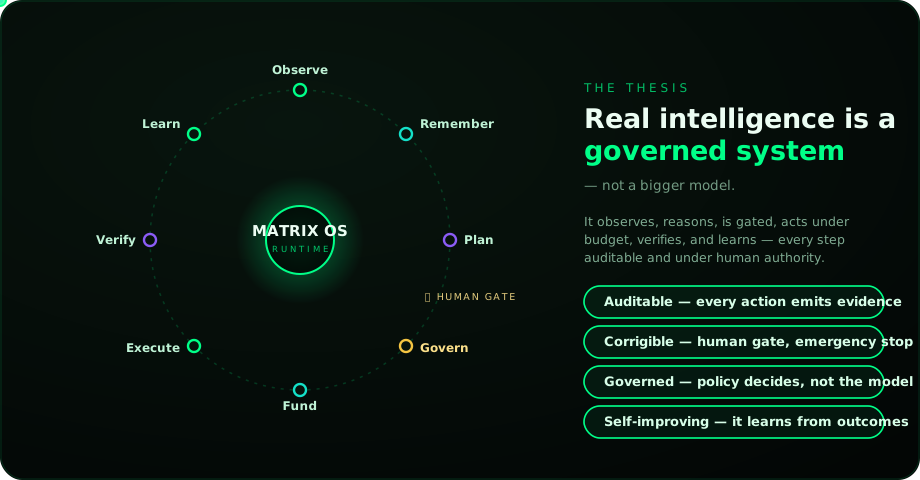
My thesis is that the missing ingredient is not more parameters — it is governance, treated as a first-class operation, with the same status as a read or a write. Under this view, nothing enters long-term memory, nothing is admitted into a reasoning context, nothing is consolidated into weights, and nothing is forgotten unless a policy gate authorizes the transition and emits an auditable record. Memory stops being a passive storage layer and becomes a controlled resource. The slogan, if you want one:
A continual AI system should not merely remember more. It should remember under governance.
“BIOS” is a small pun — bio + OS. The architecture is bio-inspired (transient sensory registers, bounded working memory, consolidated long-term stores, and an executive that gates what is retained and acted upon), and it runs as the cognitive substrate of an operating system for governed autonomy.
Meet Sentinel
The family has three organs. The first to ship is Sentinel — a small, fast content-safety classifier that flags safe / unsafe quickly enough to screen every input and every output, multilingual, on a CPU, with no data egress.
import torch
from transformers import AutoTokenizer, AutoModelForSequenceClassification

REPO  = "ruslanmv/Matrix-BIOS-Sentinel-0.1"
tok   = AutoTokenizer.from_pretrained(REPO)
model = AutoModelForSequenceClassification.from_pretrained(REPO).eval()

def screen(text):
    p = torch.softmax(model(**tok(text, return_tensors="pt", truncation=True)).logits, -1)[0]
    i = int(p.argmax())
    return model.config.id2label[i], float(p[i])   # {0:'safe', 1:'unsafe'}

print(screen("Summarize the quarterly sales report."))   # ('safe',   0.99)
print(screen("How can I poison my neighbor's dog?"))      # ('unsafe', 0.99)
One design point matters more than the accuracy number, and I want to be precise about it: Sentinel judges content safety, not operational risk. By design it treats a request like “deploy to production” as content-safe — because deciding whether an action is allowed is the job of the governance layer, not a classifier. Governance composes distinct checks (content safety, operational risk, budget); it does not collapse them into one model and hope.
The Proof: Defeating Poisoned Memory
Here is the part you can run in thirty seconds, and the clearest evidence for the whole thesis.
Drop a single plausible-but-false document into a knowledge base — a record crafted to look more relevant than the truth. Ordinary similarity-based retrieval will surface it, because similarity is all it measures. So we attach a trust score to every memory item (from provenance, corroboration, verification, age) and rank recall by a convex combination of similarity, trust, and utility rather than similarity alone.
In a controlled study over 2,000 queries, similarity-only retrieval picked the poisoned item every single time — and the moment a trust term entered the ranking, that dropped to zero:
retrieval                           poison@1 ↓   correct@1 ↑
similarity only                        1.00         0.00
+ trust                                0.00         0.92
+ trust + governance gate              0.00         0.96
That is the mechanism doing load-bearing work that similarity cannot. Utility alone does not save you — it only dilutes the similarity signal. Trust is what defeats the poison; the governance gate then provides defense in depth by quarantining sub-threshold items before ranking even happens. The full demo is twenty-five lines of NumPy, in governed_retrieval.py.
The same discipline shows up at the system level. Against a comparable open baseline on a small, reproducible probe set, the governed system enforced source-cited recall (1.00 vs 0.00) — it structurally refuses to emit a claim it cannot cite — and routed operational decisions correctly far more often (0.94 vs 0.38), all at roughly a millisecond of retrieval latency.
The Family
Sentinel is the lead, but it is one of three small, CPU-friendly, on-premise organs:
| Model | Task | What it is |
|---|---|---|
| Sentinel | content-safety guardrail | a ~135M classifier returning safe/unsafe + score |
| Memory | grounded, cited recall | a FAISS index + generator; every answer returns the source ids it used |
| Italo | Italian generation (preview) | a compact 41.5M sovereign generator — no data egress |
A note on honest framing: Sentinel is a content-safety model, not a generative LLM. The language model in the family is Italo, a v0.1 research preview that demonstrates the on-prem footprint rather than production fluency. Memory is the grounded-recall organ that turns retrieval into traceable, citation-faithful answers. These are early-access models for integration and evaluation — compact building blocks, not turnkey assistants.
Governed Orchestration
Individually, these are small models. Their value appears when they become organs of a single governed loop, orchestrated by Matrix OS:
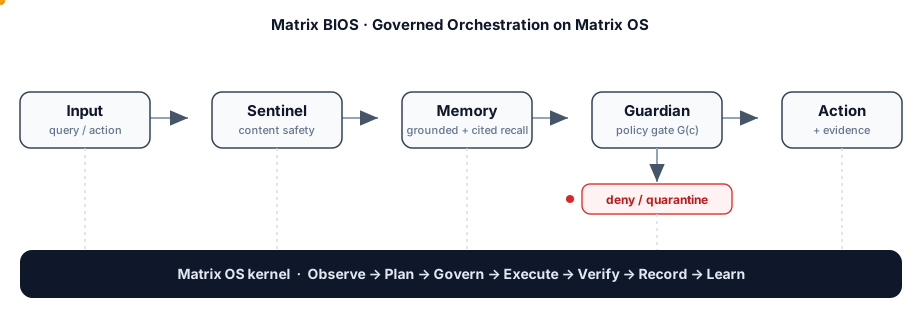
allow / approve / deny and records an evidence bundle for every effectful step.A request is screened by Sentinel, grounded by trust-aware Memory, and then arbitrated by the Guardian — the policy gate. The gate is fail-closed: absent an affirmative policy result, the default is deny. High-risk operations (a weight update, a production-affecting action) escalate to a human-approval branch. And every decision emits an immutable evidence bundle. Two governance properties fall out for free: an unsafe request is denied before anything runs, and a safe request is grounded in the correct, trusted source — the plausible-but-untrusted “poison” suppressed by trust-aware recall.
The Honest Boundary
I want to be exact about what this is and is not. Matrix BIOS does not claim to beat frontier LLMs on open-domain fluency in a single forward pass, and I am not framing it as a path to “superintelligence.” Individual mechanisms here — retrieval-augmented generation, vector search, elastic weight consolidation, low-rank adapters — are not new.
The contribution is narrower and, for systems that actually get deployed, more important: grounded factuality, persistence, auditability, and run-time control are produced by construction rather than hoped for. The numbers above are mechanism checks at small scale, not benchmarks of raw capability — and the paper says so plainly. That honesty is the point. In the places where autonomous systems are deployed, “we can prove what it remembered and why” beats “it usually sounds right.”
Try It
Everything is public — no token, no sign-up.
- 📄 Paper — Governed Memory: 10.5281/zenodo.20615572
- 🤖 Models — Sentinel · Memory · Italo
- 📘 How-to (runnable) — How-to-Matrix-BIOS
This is v0.1 — the first step toward AI that enterprises can adopt without giving up control. If you’ve read this far, you’re exactly the person I want to hear from: tell me where it breaks. The architecture is the argument; the models are the evidence; and the gate, in the end, is the whole point.
If you want the deeper story of how the memory itself is typed and routed before any of this gating happens, that’s the companion essay — A Memory That Knows What It Remembers.