
How to Build a Governed Arcade Game with GitPilot + Matrix Builder
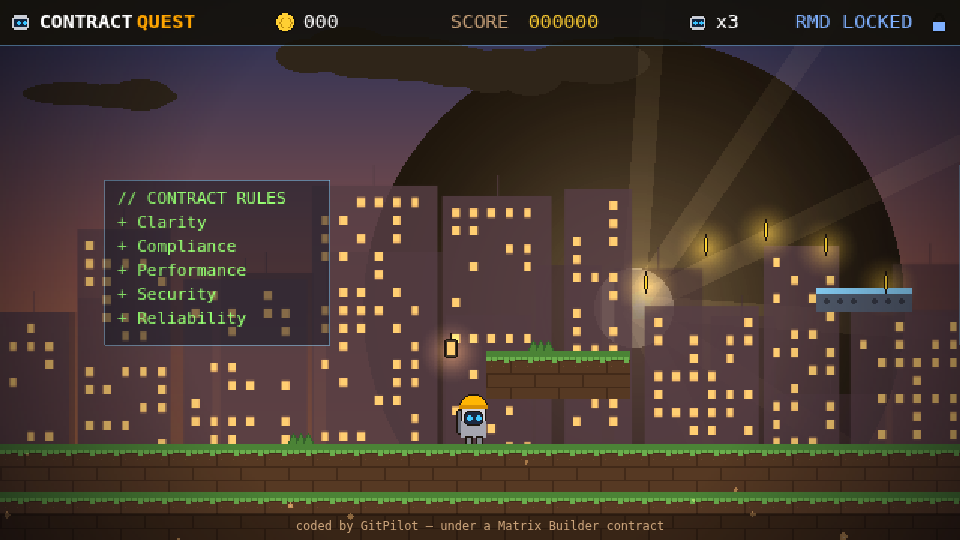
This is the playbook behind the whole under-contract arcade — Pong, Tetris, Match-3, a neon climber, and Contract Quest, a governed platformer. The thesis is simple: give the AI a contract, not a prompt. Here’s exactly how to do it, from one sentence to a polished, deployable game.
The two tools
- Matrix Builder (
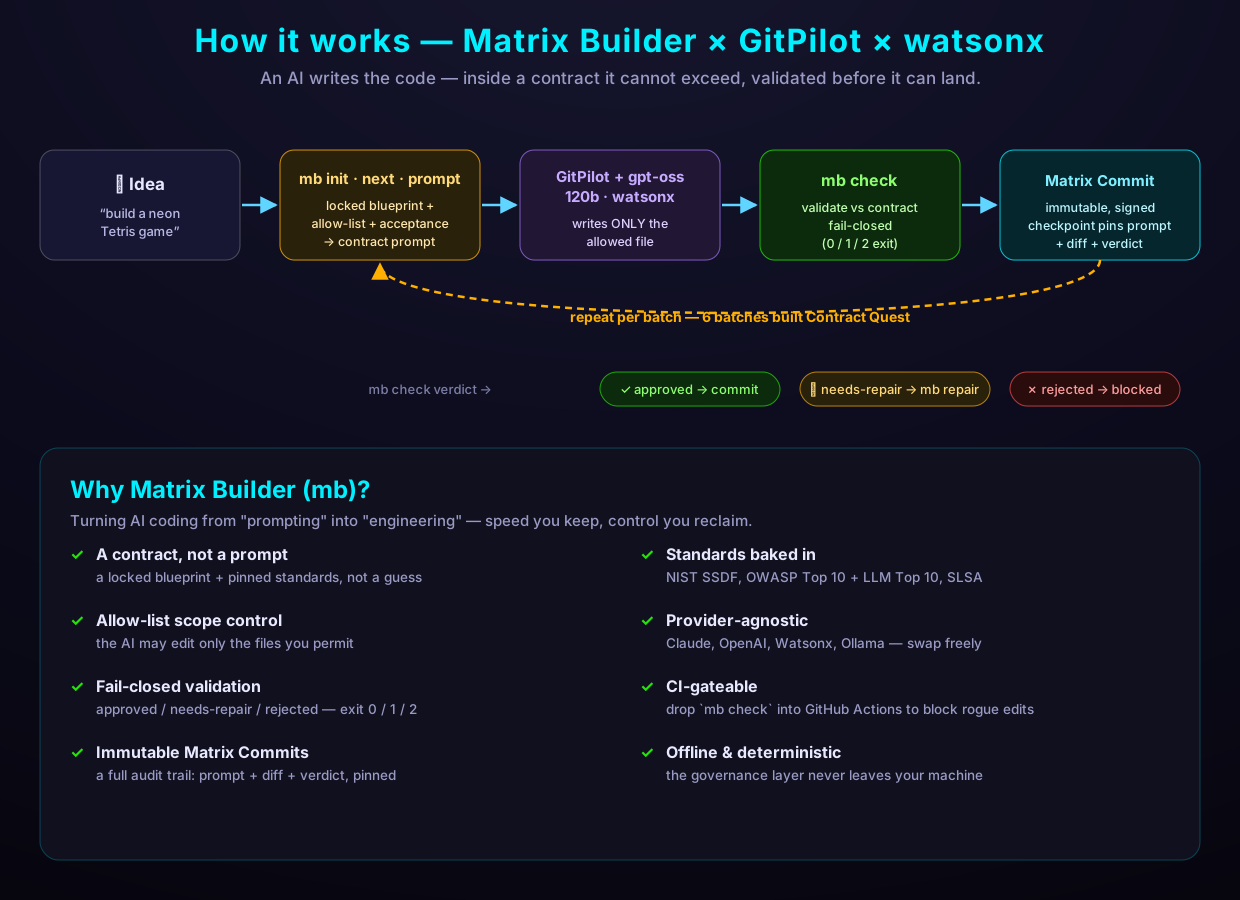
mb) — turns an idea into a Matrix Bundle: a locked blueprint, pinned standards, an allow-list of exactly which files may change, and acceptance criteria. It also validates the result (mb check: approved / needs-repair / rejected). - GitPilot — the coding agent that follows the contract. Point it at any model — Claude, OpenAI, or IBM watsonx — and it writes the code inside the allow-list.
Step 1 — Install and pick a model
pip install agent-generator gitcopilot crewai

# Option A — Claude
export GITPILOT_PROVIDER=claude GITPILOT_CLAUDE_MODEL=claude-opus-4-8 ANTHROPIC_API_KEY=sk-ant-…
# Option B — watsonx (open models)
export GITPILOT_PROVIDER=watsonx GITPILOT_WATSONX_MODEL=openai/gpt-oss-120b \
       WATSONX_API_KEY=…  WATSONX_PROJECT_ID=…  WATSONX_URL=https://us-south.ml.cloud.ibm.com
The governance never changes — only the model does. (Tip: raise GITPILOT_MAX_TOKENS for big single-file generations.)
Step 2 — The governed loop (per batch)
mb init "Contract Quest — a side-scrolling arcade platformer …" --quality standard
# then repeat, once per feature batch:
mb next "<the next batch goal>"            # plan a scoped batch (allow-list + acceptance)
mb prompt --coder gitpilot                 # render the contract-bound prompt
gitpilot generate -m "$(cat coder-prompts/gitpilot.md)" -o .
mb check frontend/index.html               # validate, fail-closed → Matrix Commit
Build the game in batches — foundation, controls, collectibles, enemies, levels, polish — each one validated before it can land. If the model writes outside the allow-list, mb check returns needs-repair and nothing ships. That’s the whole point: proof, not vibes.
Step 3 — Two ways to build (pick by ambition)
A. Single self-contained frontend/index.html — canvas + JS, no build step. Perfect for prototypes and game jams; instantly playable on GitHub Pages. This is how the watsonx Contract Quest prototype was built — 6 governed batches + a self-repair.
B. A real engine — Vite + TypeScript + Phaser 3, for a production game with scenes, entities, tilemaps, animation, and CI. The architecture lives in ruslanmv/contract-quest:
src/
  main.ts                 # Phaser config (pixelArt, Arcade physics, FIT scale)
  scenes/{Boot,Preload,Game}.ts
  entities/{Player,BugBot,Slime,Coin}.ts
  ui/{HUD,TouchControls}.ts
  utils/{constants,textures}.ts
public/assets/            # sprites, tiles, backgrounds (loaded at runtime)
.github/workflows/deploy.yml   # typecheck → build → deploy to Pages
MATRIX_*.{yaml,lock,md}        # the contract identity + RMD governance
Reproduce it locally:
git clone https://github.com/ruslanmv/contract-quest && cd contract-quest
npm install && npm run dev      # → http://localhost:5173/
Step 4 — Make it look premium (the part everyone misses)
Here’s the hard truth: an LLM that writes code can’t paint pixel art. The gorgeous look is an asset problem, not a prompt problem. Same engine, different art = a totally different game:

The pipeline:
- Generate the art with a pixel-art image model (Midjourney / SDXL / DALL·E) or Aseprite; lay out levels in Tiled. (Contract Quest ships
scripts/gen_assets.pyto generate an original placeholder set programmatically — hero sprite sheet, tiles, parallax skylines, coins, gate, HUD icons — so it looks good immediately.) - Drop the PNGs into
public/assets/with the same names/sizes — the engine’sPreloadSceneloads them, builds animations, andGameScenerenders parallax layers, glow/bloom, particles, a color-grade, and an icon HUD with zero code changes. - To match a concept render exactly, follow the prompt pack in
docs/ASSET_PROMPTS.md.
The division of labor: GitPilot (any model, under contract) writes the engineering; an image model / artist provides the art. Matrix Builder keeps both honest.
Step 5 — Ship it
CI (typecheck → build → deploy) publishes dist/ to GitHub Pages. Set base in vite.config.ts to /<repo>/, enable Settings → Pages → GitHub Actions, and you’re live.
Step 6 — Scale safely: an 8-episode campaign, additive by design
A prototype is one level. A real game is a campaign — and this is where most “AI built a game” demos fall apart: every new level means another sprawling, ungoverned edit. The fix is the same discipline as the batches: make content data, not code.
Contract Quest grew into a Super Mario Bros-style 8-episode quest — a story (the Builder restoring corrupted realms), per-episode narrative cards, power-ups, a Rogue Architect boss, and end credits — without rewriting the engine. Each episode is one small config object:
// src/levels/episodes.ts  — adding an episode = adding ONE entry. The engine never changes.
{
  id: 4, title: "IV — The Parallax Heights", subtitle: "Ascend",
  story: ["The spires of the old build pierce the dusk.", "Climb. The higher contracts await."],
  width: 3000, platforms: 10, enemies: 5, slimeRatio: 0.5, moving: true,
  coinArcs: 4, djump: true, accent: 0x00f0ff, seed: 44,
}
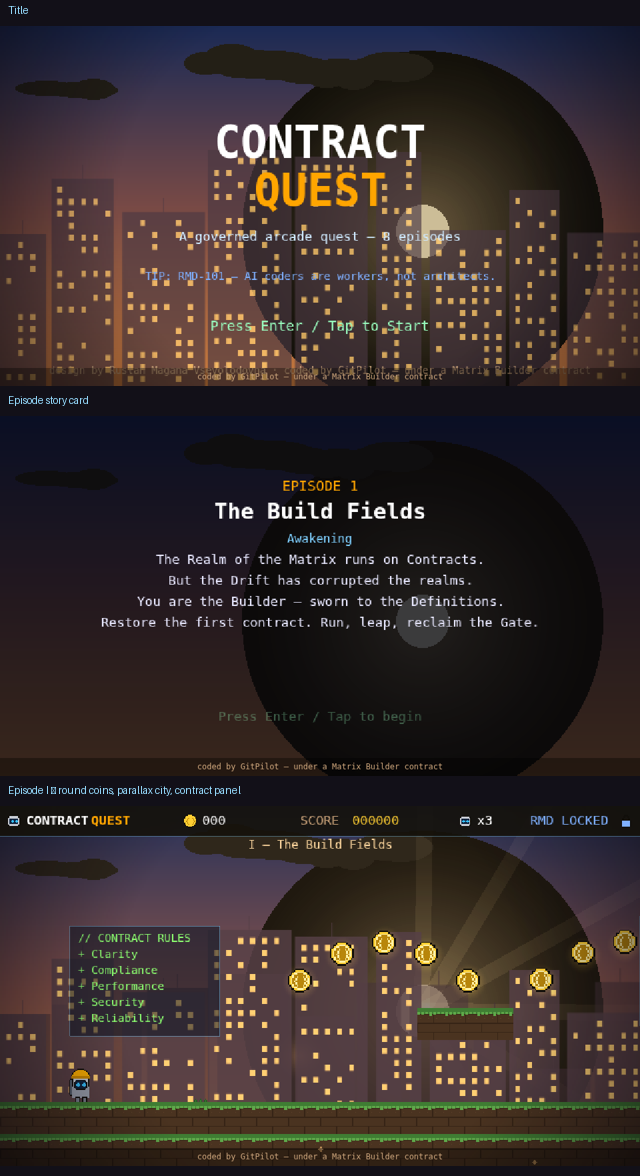
This is the scalability story in one pattern. An episode is just a batch in another form: small, scoped, validated, additive. A whole team — or a fleet of contract-bound AI agents — can add episodes, enemies, and mechanics in parallel; the engine, the standards, and the mb check gate stay fixed. You grow a 56 KB demo into a real title the same way you’d grow a 10-million-line engine: content scales, governance holds. That’s how this technology takes complex projects — up to AAA — safely.
Take it further
- Contract Quest (engine): github.com/ruslanmv/contract-quest
- Contract Quest (watsonx prototype): github.com/ruslanmv/contract-quest-watsonx
- Matrix Builder: agent-matrix/matrix-builder · GitPilot: gitpilot.ruslanmv.com
- The arcade: Pong · Tetris · Match-3 · Neon Climber
The takeaway is the method, not the game: give an AI a contract instead of a prompt, and keep the evidence of what it changed. A small demo and a large engine are built the same way — the content scales, and the governance holds.
Leave a comment