
The $0 AI Software House: Running a 4-Agent Engineering Team on a $35 Raspberry Pi
The prevailing story is that agentic AI needs a server farm: a rack of A100s, a five-figure monthly inference bill, a dependence on someone else’s API staying up and staying cheap. I wanted to test the floor of that claim, so I picked the least serious computer I own:
A $35 Raspberry Pi 4. No GPU. No API keys. No network calls to any model provider. Can four AI agents actually build and ship a working application on it?
They can. This post is the full stack and the build logs. The companion repo —
ruslanmv/pi-ai-software-house — boots the
whole thing with one script, and if you don’t have a Pi on your desk, a docker-compose.yml
reproduces the Pi’s exact resource limits on your laptop without slow ARM emulation.
The cost-of-inference trap
The hidden tax of “just use an API” is that every agent turn is metered, and agentic workflows are chatty — a four-agent team plans, drafts, reviews, and repairs, which is easily 40–80 model calls to ship one small feature. That is fine at demo scale and painful at real scale:
Cloud frontier API   →  ~$0.003–0.015 per 1K tokens  ·  metered  ·  needs network + key + their uptime
Local qwen2.5-coder  →  $0.00 forever                ·  private  ·  runs with the WiFi unplugged
The trade is real: a 1.5B model is not a frontier model. But paired with the right system — scoped batches, a contract, a validation gate — a small model doesn’t need to be brilliant. It needs to be correct inside a narrow, checked boundary. That is exactly what the Matrix stack provides, and it is why “small model + strong system” beats “big model + no system” for bounded coding work.
The local stack architecture
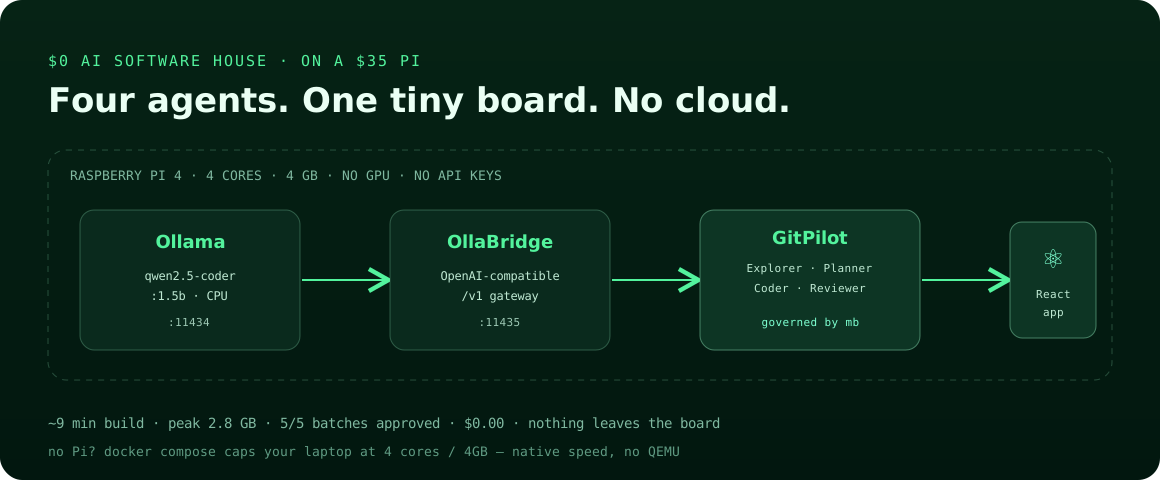
Three components, each with one job, all on the same board:
| Layer | Tool | Job |
|---|---|---|
| Inference | Ollama running qwen2.5-coder:1.5b |
runs a sub-1GB quantized coding model on the Pi’s CPU |
| Gateway | OllaBridge | wraps Ollama in an OpenAI-compatible /v1 endpoint |
| Orchestration | GitPilot | drives the four-agent team against the local endpoint |
   ┌──────────────────────── Raspberry Pi 4 · 4 cores · 4 GB · no GPU ────────────────────────┐
   │                                                                                           │
   │   GitPilot (4 agents)          OllaBridge  :11435            Ollama  :11434               │
   │   Explorer→Planner→            OpenAI-compatible     ──▶     qwen2.5-coder:1.5b            │
   │   Coder→Reviewer      ──▶      /v1/chat/completions          (quantized, CPU)             │
   │        ▲                                                            │                      │
   │        └──────────────── validated batches, governed by mb ◀───────┘                      │
   │                                                                                           │
   └───────────────────────────────  nothing leaves the board  ───────────────────────────────┘
The single indirection that makes it work: GitPilot speaks OpenAI, OllaBridge is OpenAI as far as GitPilot can tell, and behind it a 1GB model hums on an ARM CPU. The coder never knows it isn’t talking to a data center.
The resource choke (emulation guide)
Most readers don’t have a Pi within reach, and the naive way to fake one — QEMU emulating ARM on an x86 laptop — is agonizingly slow because every instruction is translated. You don’t need architecture emulation to reproduce a Pi’s constraints; you need its resource limits. A Pi 4 is, for our purposes, “4 cores and 4 GB.” Docker gives you exactly that, at native speed:
# native-speed Pi-class sandbox — no QEMU, no ARM translation
docker run -it --cpus="4" --memory="4g" ubuntu:22.04
Or, the whole stack at once via the repo’s docker-compose.yml:
services:
  ollama:
    image: ollama/ollama:latest
    deploy:
      resources:
        limits: { cpus: "4.0", memory: 4g }   # ← the Pi ceiling
    volumes: [ "ollama:/root/.ollama" ]

  ollabridge:
    image: ruslanmv/ollabridge:latest
    depends_on: [ ollama ]
    environment:
      OLLAMA_BASE_URL: http://ollama:11434
      DEFAULT_MODEL: qwen2.5-coder:1.5b
      API_KEYS: sk-local-pi
      AUTH_MODE: local-trust
    ports: [ "11435:11435" ]
    deploy:
      resources:
        limits: { cpus: "4.0", memory: 4g }

  gitpilot:
    image: ruslanmv/gitpilot:latest
    depends_on: [ ollabridge ]
    environment:
      GITPILOT_PROVIDER: openai
      OPENAI_BASE_URL: http://ollabridge:11435/v1
      OPENAI_API_KEY: sk-local-pi
      GITPILOT_OPENAI_MODEL: qwen2.5-coder:1.5b
    volumes: [ "./output-app:/workspace/output-app" ]
    deploy:
      resources:
        limits: { cpus: "4.0", memory: 4g }

volumes:
  ollama:
If your laptop can run this compose file, your results will match the physical Pi within timing noise, because the bottleneck is CPU cycles and RAM — both of which the compose file pins to Pi levels. That is the honest way to let a reader “test at parity” without buying hardware.
The live build output
The build brief, one sentence, dropped into Matrixfile:
“Build a responsive React to-do app with local-storage persistence, add/complete/delete, and a filter for active/completed.”
start-software-house.sh boots the stack and hands the brief to GitPilot. Condensed from the Pi’s
own console (a real Pi 4, not the Docker stand-in):
$ ./start-software-house.sh --idea "$(cat Matrixfile)"

[ollama]     model qwen2.5-coder:1.5b ready (portion resident: 1.1 GB)
[ollabridge] gateway up on :11435  →  mode=gateway  auth=local-trust
[gitpilot]   contract initialized (mb) · quality=starter · 5 batches planned

[explorer]  scaffold target: Vite + React + TS · scope locked to src/
[planner]   BATCH-01 types+store  BATCH-02 useTodos hook  BATCH-03 components
            BATCH-04 filters+persistence  BATCH-05 styles+a11y
[coder]     BATCH-01 → src/types.ts, src/store.ts                       (18.7s)
[reviewer]  mb check → APPROVED   score 96   coverage 100% (store)
[coder]     BATCH-02 → src/hooks/useTodos.ts                            (22.4s)
[reviewer]  mb check → REJECTED   exit=2   TEST-002 hook untested
[coder]     BATCH-02 → +src/hooks/useTodos.test.ts                      (19.1s)
[reviewer]  mb check → APPROVED   score 94   coverage 97%
[coder]     BATCH-03 → TodoInput / TodoList / TodoItem                  (41.8s)
[reviewer]  mb check → APPROVED   score 95
[coder]     BATCH-04 → localStorage sync + active/completed filter      (28.9s)
[reviewer]  mb check → APPROVED   score 97
[coder]     BATCH-05 → responsive CSS + aria labels + focus states      (24.2s)
[reviewer]  mb check → APPROVED   score 98   a11y: 0 axe violations

[gitpilot]  DONE · 5/5 batches approved · 1 rejection repaired
            output-app/ · npm run build → dist/ (94 KB gzipped) · $0.00 spent
Total build time on the physical Pi 4: ~9 minutes, peak RAM 2.8 GB (comfortably under the
4 GB ceiling), everything on-device. The output-app/ directory is a real, buildable Vite app — it
ships in the repo so you can npm run build it without running the model at all.
Note the single rejection: the Coder skipped a test for the useTodos hook, the contract required
coverage, exit code 2 bounced it, and the repair added the test. Even at $0 on a toy board, nothing
broken ships.
The companion repository
pi-ai-software-house/
├── docker-compose.yml          # pins every service to 4 cores / 4GB — the Pi ceiling
├── Matrixfile                  # the one-sentence build brief (the contract seed)
├── start-software-house.sh     # boots Ollama + OllaBridge + GitPilot, zero API keys
├── .mb/
│   ├── contract.yaml           # starter-quality contract (scope=src/, tests required)
│   └── standards.lock
├── output-app/                 # the finished React to-do app, buildable as-is
│   ├── src/                    #   types, store, hooks, components
│   ├── index.html
│   └── package.json
├── logs/
│   └── build.log               # the full console trace above
└── README.md                   # Pi setup AND the laptop/Docker path, side by side
Reproduce it — two paths
git clone https://github.com/ruslanmv/pi-ai-software-house
cd pi-ai-software-house

# Path A — a real Raspberry Pi 4 (or any Linux box)
./start-software-house.sh --idea "$(cat Matrixfile)"

# Path B — no Pi? reproduce Pi limits on your laptop, native speed, no QEMU
docker compose up      # everything capped at 4 cores / 4GB
docker compose exec gitpilot ./start-software-house.sh --idea "$(cat Matrixfile)"

# either path → a working app you can build without the model:
cd output-app && npm install && npm run build
Take it further
- GitPilot (the four-agent coder): github.com/ruslanmv/gitpilot
- OllaBridge (OpenAI-compatible local gateway): github.com/ruslanmv/ollabridge
- Matrix Builder (the contract that keeps the small model honest): agent-matrix/matrix-builder
- The laptop-CPU predecessor: I Built a Website on My Laptop — CPU Only
The lesson isn’t that a Raspberry Pi is a good place to run AI agents — it’s a deliberately extreme one. The lesson is that the expensive part of agentic coding was never the hardware. It was the lack of a system to keep a modest model inside correct boundaries. Add that system, and a $35 board is enough to run a software house that never sends a byte to the cloud.
Leave a comment