
I Didn’t Write This Pong Game — Claude Opus 4.8 Did, Under Contract
You’ve seen the headline a hundred times: “I asked an AI to build X and it did!” — and then you open the repo and it’s a 600-line diff that touched twelve files you never mentioned, invented two dependencies, and edited the CI config “to help.” It works, maybe. But could you prove what the AI was allowed to do?
This time I wanted the proof. So I let Claude Opus 4.8 build a complete retro Pong game — but I refused to give it a prompt. I gave it a contract. And I kept the receipts.
🎮 Play it first
▶ Play Pong Under Contract — one self-contained HTML file an AI wrote. Beat the CPU to 11. Move with
W/S, arrows, or touch.
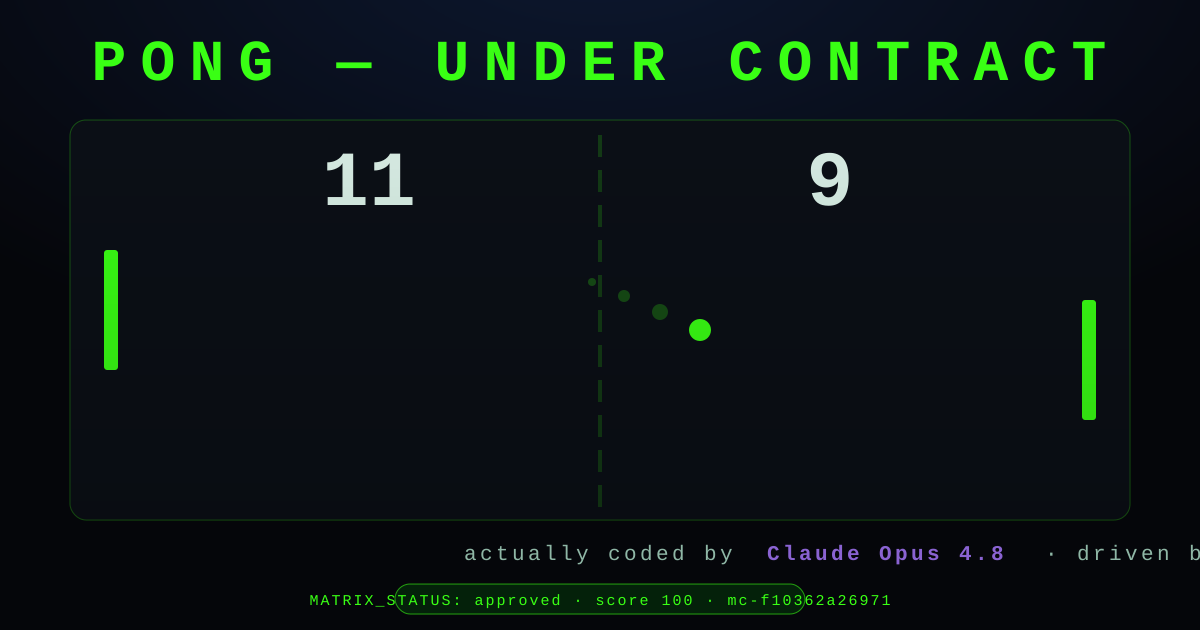
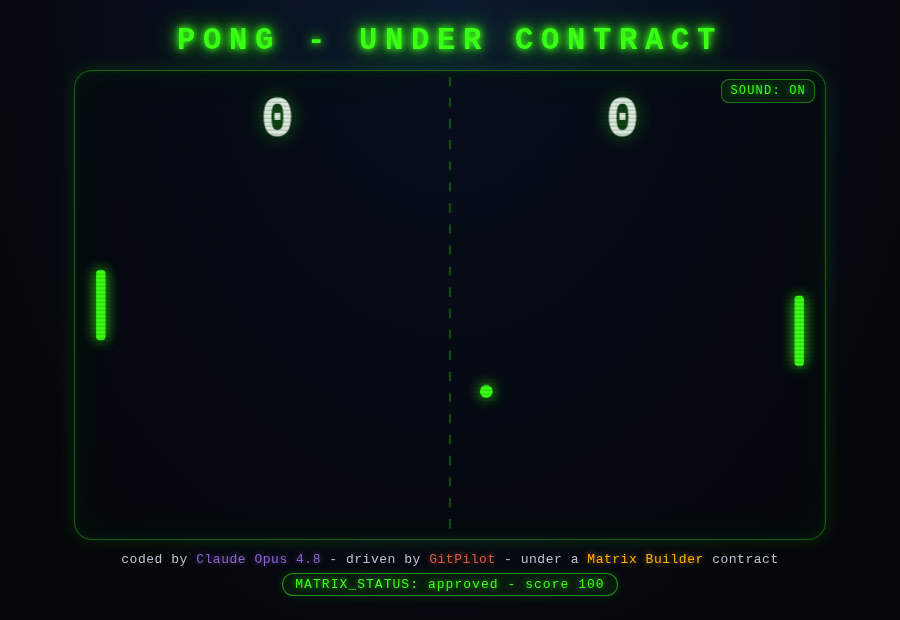
And here’s the actual game running in a browser — a real headless capture, not a mock-up: glowing neon paddles and ball, a dashed center net, CRT scanlines, and the build credit baked right in.
Everything is open at github.com/ruslanmv/pong-under-contract — including the Matrix Bundle that governed the build and an EVIDENCE.md recording the exact run.
Two tools, one idea: control, not vibes
- Matrix Builder gives AI coders a contract, not a prompt — a Matrix Bundle with a locked blueprint, a pinned standards file, an allow-list of exactly which files may change, and acceptance criteria. The
mbCLI ships inagent-generatorand runs offline. - GitPilot is the open-source multi-agent coding assistant and the native worker for Matrix Builder. It runs any LLM — OpenAI, Anthropic Claude, IBM Watsonx, or Ollama (local & free). Claude is in fact its default provider.
One plans. One executes. And a validator stands between the model and your main branch.
Exactly how I built it — step by step, in the terminal
I did the whole thing from the command line, not the VS Code extension or the web app — because the CLI is scriptable and every step is reproducible. Two CLIs do the work: mb (Matrix Builder, ships inside agent-generator) and gitpilot (the GitPilot CLI). Here is every step I ran.
Step 0 — Install the three tools
pip install agent-generator   # the `mb` CLI — Matrix Builder + the contract engine
pip install gitcopilot        # the `gitpilot` CLI — the AI coder
pip install crewai            # the agent runtime GitPilot uses to call the LLM
Step 1 — Point GitPilot at Claude Opus 4.8
GitPilot reads three environment variables to choose the provider, model, and key — that’s the entire configuration:
export GITPILOT_PROVIDER=claude            # Claude is GitPilot's default provider
export GITPILOT_CLAUDE_MODEL=claude-opus-4-8
export ANTHROPIC_API_KEY=sk-ant-…          # your Anthropic key
Swap these three for openai, watsonx, or ollama (local & free) and nothing else in the process changes.
Step 2 — Turn one sentence into a contract (mb)
mb init "A retro Pong arcade game … single self-contained HTML file …" --quality standard
mb next "Build the complete Pong game in one self-contained frontend/index.html"
mb next plans a scoped batch. I reviewed it and set the allow-list to the single file the game needs — frontend/index.html — then rendered the contract-bound prompt for the coder:
mb prompt --coder gitpilot # writes coder-prompts/gitpilot.md (+ .gitpilotrules)
That prompt isn’t “please build Pong.” It’s a contract: implement TASK-002 only; edit ONLY frontend/index.html (RMD-002, RMD-107); don’t add dependencies (RMD-105); end with MATRIX_STATUS. Those RMD-xxx rules bake in NIST SSDF, OWASP Top 10 & OWASP LLM Top 10, and SLSA.
Step 3 — Let Claude write the game, through GitPilot (gitpilot generate)
I piped the contract prompt straight into GitPilot’s local generator. This is the line where the AI actually writes the code:
gitpilot generate -m "$(cat coder-prompts/gitpilot.md)" -o .
Provider: claude · Model: claude-opus-4-8
Generating... done
  Created: frontend/index.html (15027 bytes)
Generated 1 file(s)
GitPilot called Claude Opus 4.8 and wrote exactly one file — the allow-listed one. No stray configs, no invented dependencies. The model produced a genuinely good game, too: angle-based paddle bounce, a ball that speeds up, a capped-speed AI, keyboard and touch controls, and a win screen at 11.
Step 4 — Validate the AI’s output — before it can land (mb check)
mb check frontend/index.html
MATRIX_STATUS: approved  score=100
  committed mc-caf49981d56a        # ← an immutable, versioned Matrix Commit
approved, score 100 — so the change matured into a Matrix Commit pinning the prompt, the diff, the standards lock, and the verdict. Everything above — provider, model, command, byte count, verdict — is recorded verbatim in EVIDENCE.md. This is the difference between “looks done” and proof.
Step 5 — Sanity-check that it actually runs
node --check script.js # extracted <script> → valid JavaScript, no syntax errors
A quick grep confirmed the canvas, game loop, input handlers, score-to-11, and win screen were all present.
Step 6 — Ship it
Commit, push, and let CI re-run the very same mb check as a gate before deploying the game to GitHub Pages (.github/workflows/contract.yml). If the contract isn’t satisfied, the deploy never happens.
CLI or desktop? I used the headless
gitpilot generatecommand in a terminal. The same GitPilot engine also runs as a VS Code extension and as a web app at gitpilot.ruslanmv.com. There, instead of piping the prompt on the command line, you’d paste themb promptoutput into GitPilot’s chat and approve each diff in the UI (Ask mode). The contract (mb) and the verdict (mb check) are identical either way — only the surface changes.
“But what if the model colors outside the lines?”
Then it doesn’t ship. mb check is fail-closed — exit 0 approved · 1 needs-repair · 2 rejected. If the model writes to a file outside the allow-list, the verdict flips to needs-repair and mb repair generates a tightly-scoped fix prompt. The demo repo enforces exactly this in CI (.github/workflows/contract.yml): the pipeline re-runs mb check and refuses to deploy unless the verdict is approved. In this build it ran green on a real GitHub Actions runner.
From prompting to engineering
| Prompting | Engineering — Matrix Builder + GitPilot + Claude |
|---|---|
| “Build me Pong” → 🤞 | A blueprint, an allow-list, acceptance criteria |
| Edits anything, anywhere | Claude wrote only frontend/index.html |
| Un-reviewable diff | One scoped diff + a recorded run |
| “Looks done?” | MATRIX_STATUS: approved score=100 + a signed commit |
| Trust | Proof |
It works the same whether the coder is Claude Opus 4.8 or a tiny local model. In an earlier post I ran the identical loop with a 1.5B model on OllaBridge’s free tier — kept inside the contract, even a micro-model produced a safe, committed patch. Swap the model; the governance never changes.
Reproduce it
pip install agent-generator gitcopilot crewai
mb init "your idea here" --quality standard && mb next "first feature"
mb prompt --coder gitpilot
export GITPILOT_PROVIDER=claude GITPILOT_CLAUDE_MODEL=claude-opus-4-8 ANTHROPIC_API_KEY=sk-ant-…
gitpilot generate -m "$(cat coder-prompts/gitpilot.md)" -o .
mb check <files you allowed it to touch>
Take it for a spin
- Play / fork: github.com/ruslanmv/pong-under-contract — read
EVIDENCE.mdand audit.mb/. - Matrix Builder: agent-matrix/matrix-builder
- GitPilot: gitpilot.ruslanmv.com
- Engine +
mb: ruslanmv/agent-generator
The next time an AI writes your code, don’t ask it to behave — give it a contract, and keep the record of what it changed.
If auditable, in-scope AI development is the direction you care about, the whole project is open — the code, the evidence, and the Matrix bundle — at pong-under-contract.
Leave a comment