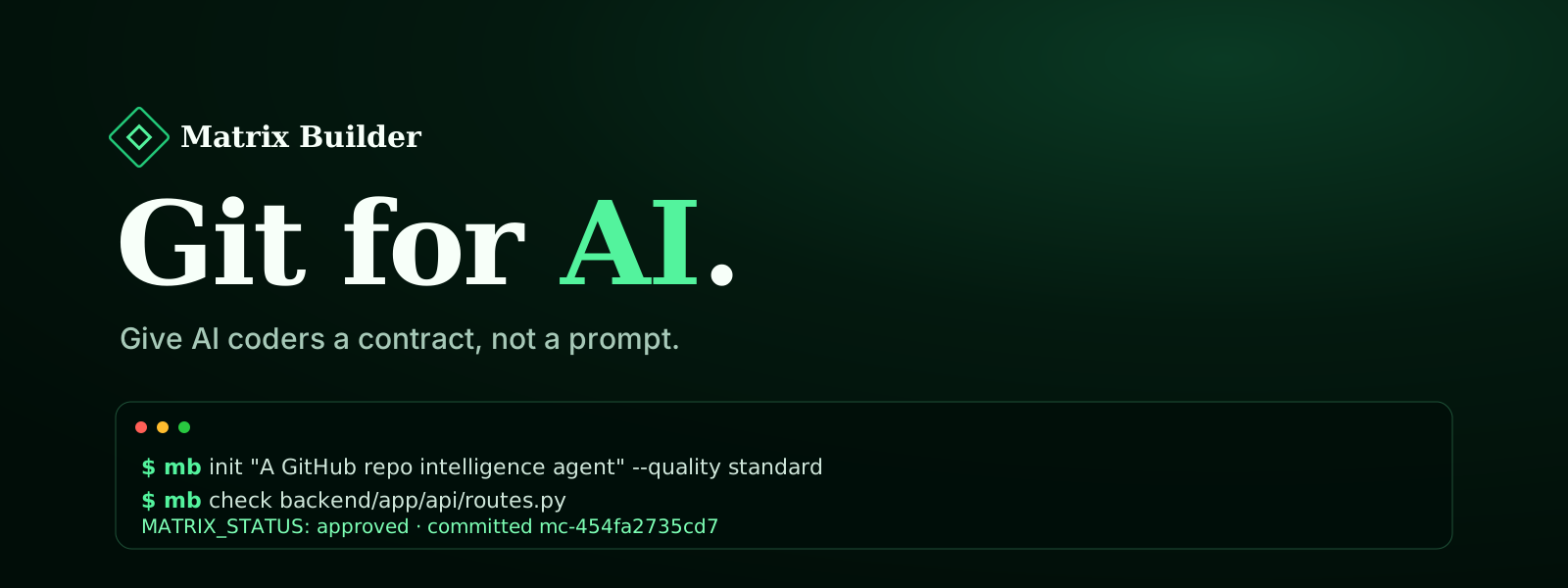

Give Your AI Coder a Contract: A 2-Minute Tour of Matrix Builder (mb)
AI writes code in seconds — then promptly forgets the rules, wanders off your architecture, and quietly edits files it shouldn’t touch. We’ve all been there: a single loose prompt turns a clean codebase into an un-reviewable, 400-line diff nightmare.
Matrix Builder fixes that structural breakdown. It shifts the paradigm by giving every AI coder a contract, not a prompt — and versioning every single change exactly like Git.
The local tool is mb. It’s completely offline, deterministic, and requires nothing but a standard Python environment. Let’s run it end-to-end.
Install (one line)
pip install agent-generator        # ships the `mb` CLI + the core engine
mb --version
# mb (agent-generator) 0.2.0
No remote servers, no mandatory database, and no prerequisite API keys.
The whole loop, in your terminal
Here’s how the control loop works when you want to build a feature cleanly:
# 1) Turn an idea into a controlled blueprint (housed locally in ./.mb/)
$ mb init "A GitHub repo intelligence agent" --quality standard
Initialized .mb/ for Standard Matrix Bundle
  project    bp-56d0c6f90021
  version    v1.0.0  ·  quality standard
  blueprint  1 task(s)  ·  stack fastapi/nextjs

# 2) Plan one scoped batch — it explicitly declares allowed files + acceptance checks
$ mb next "Add repo ingestion"
Batch 01  Add repo ingestion  (add-feature)
  TASK-002: Apply the requested update
    - backend/app/api/routes.py
    - backend/tests/test_routes.py
  acceptance: pytest -q, ruff check ., npm run build

# 3) Generate a contract-bound prompt for your AI coder (Claude Code, Cursor, GitPilot…)
$ mb prompt --coder claude-code
You are Claude Code, an expert software engineer.
…
Governing rules: RMD-101 … RMD-120.
End your response with: MATRIX_STATUS: approved | needs_repair | rejected
# (paste this into your AI coder — the framework forces it to stay inside allowed files)

# 4) Validate what the AI changed — this is where the magic happens
$ mb check backend/app/api/routes.py
MATRIX_STATUS: approved  score=100
  committed mc-454fa2735cd7        # ← an immutable, versioned Matrix Commit
Watching the contract hold
What happens if the AI tries to color outside the lines? Let’s intentionally tell it to modify a locked configuration file:
$ mb check MATRIX_BLUEPRINT.yaml
MATRIX_STATUS: rejected  score=60
  -  RMD-002: Modified a forbidden contract file: MATRIX_BLUEPRINT.yaml
  next      mb repair --copy
Instantly rejected. mb repair handles the failure gracefully by generating a tightly scoped repair prompt to feed back to the AI. And you can audit your entire structural progress at any time:
$ mb timeline
Standard Matrix Bundle  v1.0.0  ·  A GitHub repo intelligence agent
  Batch 01  Add repo ingestion  (add-feature)
           ✓ commit 001 mc-454fa2735cd7
What just happened behind the scenes?
Every accepted change automatically matures into a Matrix Commit — an immutable checkpoint pinning the exact prompt, the generated diff, the standards lock, and the validation result.
Because mb check is rigorously fail-closed (exit codes: 0 approved · 1 needs-repair · 2 rejected), you can drop it straight into GitHub Actions or any CI pipeline to gate rogue AI edits.
And the guardrails aren’t arbitrary. Every build is locked to the signed Ruslan Magana Definitions (RMD), which bake in industry security baselines:
- NIST SSDF — Secure Software Development Framework
- OWASP Top 10 & OWASP LLM Top 10
- SLSA — Supply-chain Levels for Software Artifacts
Your AI coder finally behaves like a disciplined engineer following a strict blueprint — not a rogue agent guessing its way through production code.
Direct evaluation: testing with a free cloud LLM
The terminal loop above hands the prompt to you to feed your favorite IDE tool. But since mb is fundamentally an engine, I pushed it further: I wired a lightweight AI bridge that captures the output of mb prompt, dispatches it to a remote model, writes the returned code to disk, and runs mb check to close the loop automatically.
The beauty is in the routing — only one step ever leaves your machine. Everything else (planning, validation, committing) stays local and deterministic:
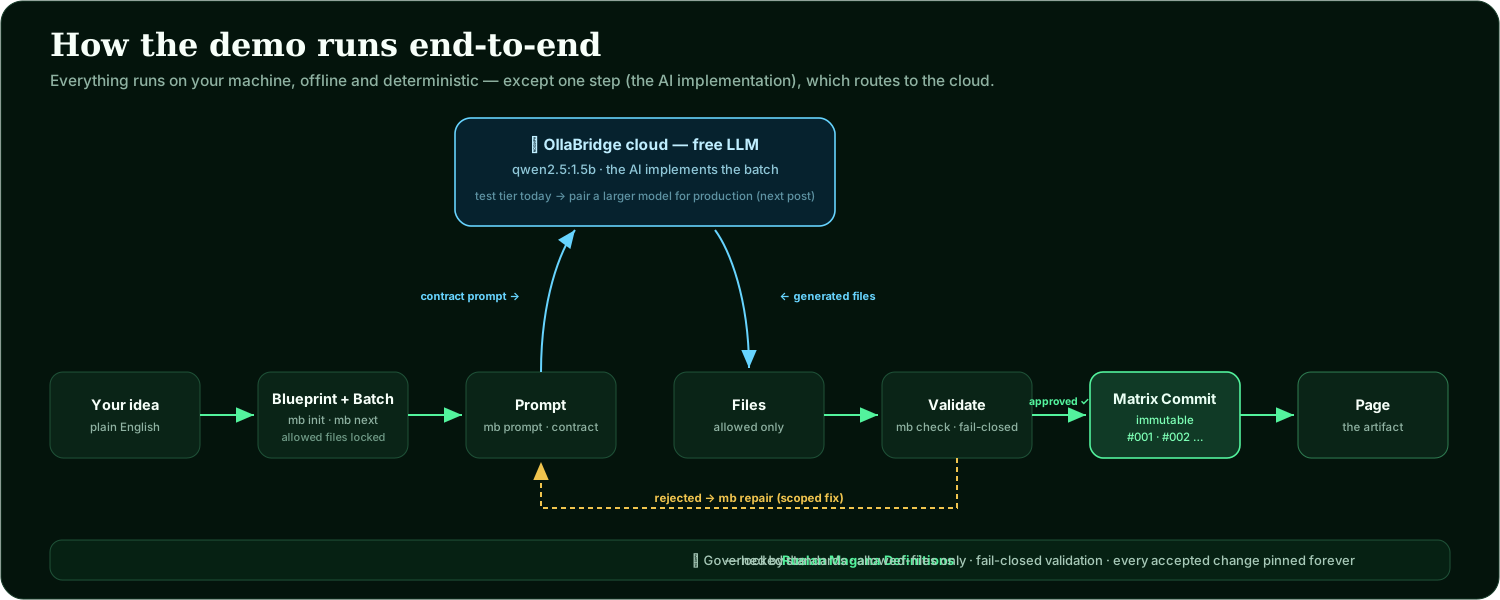
For the AI engine, I opted for a deliberately brutal stress test: OllaBridge’s free cloud tier running qwen2.5:1.5b — an OpenAI-compatible endpoint that needs no API key. The question: can a tiny, heavily constrained 1.5B model navigate the contract framework at all?
$ mb init "A simple hello world web page" --quality starter
Initialized .mb/ for Starter controlled blueprint   ·   stack fastapi/nextjs

$ mb next "Create the hello world landing page"
Batch 01  Create the hello world landing page  (add-feature)
  allowed files: backend/app/api/routes.py · backend/tests/test_routes.py

$ mb prompt --coder generic --file prompt.md      # generates the contract prompt
#  → AI bridge posts prompt.md to OllaBridge free tier (qwen2.5:1.5b) … ~5s
#  → writes the files it returned, safely inside allowed paths

$ mb check backend/app/api/routes.py backend/tests/test_routes.py
MATRIX_STATUS: approved  score=100
  committed mc-f5e6ed8fb23e
The tiny model even abided by the contract’s stop condition, ending its raw stream with exactly MATRIX_STATUS: approved. The result was a working FastAPI route serving our target page:

An honest post-mortem: a 1.5B-parameter model isn’t flawless — on the first pass it slipped on a minor import (
HTMLResponsebelongs infastapi.responses). But that is the thesis: kept strictly inside a build contract, even a micro-sized model produced a safe, auditable, committed patch in seconds. Scaling this exact pipeline to a larger paired OllaBridge model — or an elite frontier coder — makes the output production-clean immediately, and the governance layer stays perfectly unchanged. (That’s a topic for the next post.)
Why this matters: from “prompting” to “engineering”
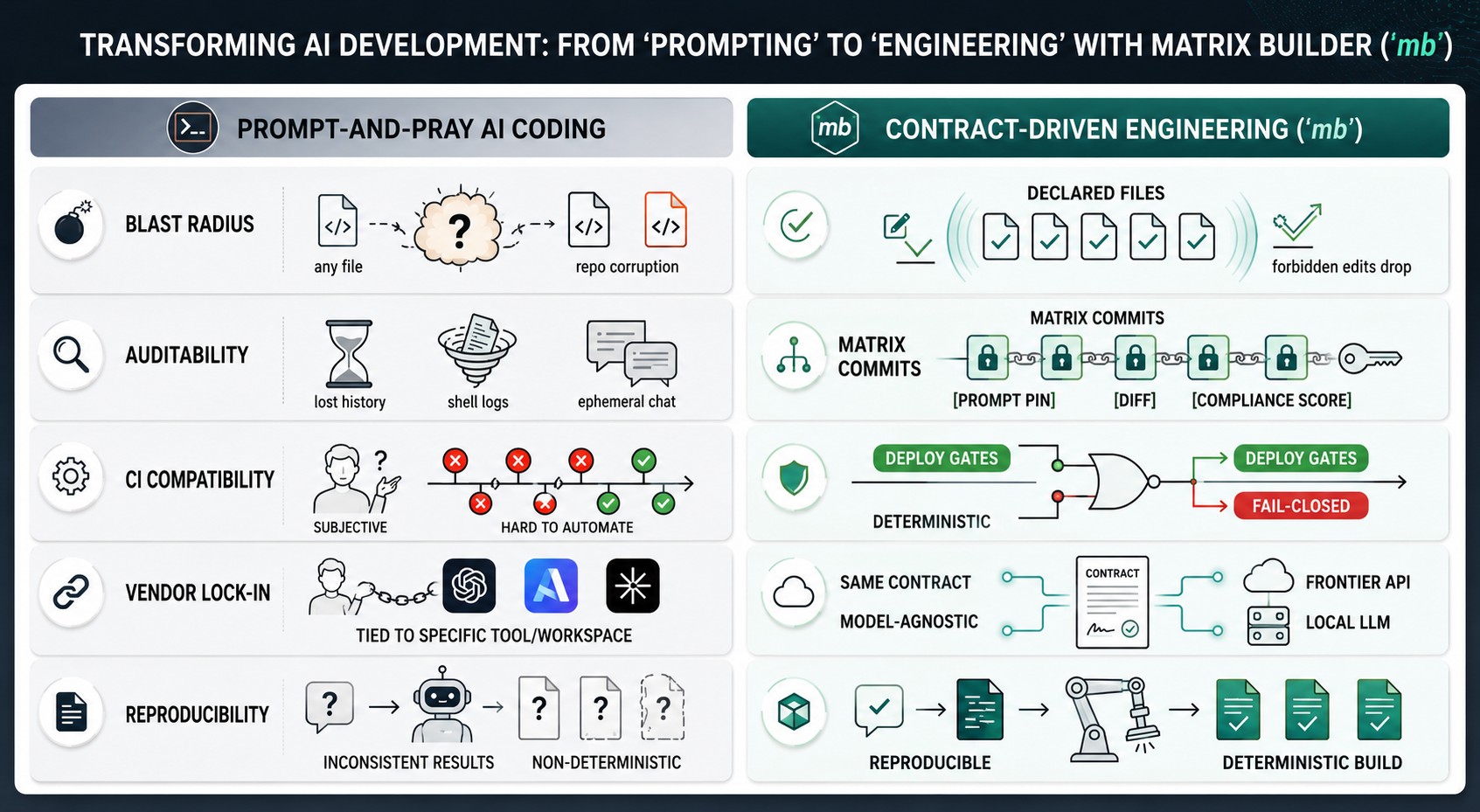
As shown in the comparison above, the difference between these two worlds isn’t just a matter of syntax—it’s a fundamental shift in operational philosophy.
Ultimately, moving from “prompting” to “engineering” means trading chaos for control. By forcing the AI to work within a strict execution boundary, Matrix Builder stops treating LLMs like unpredictable wizards and starts treating them like deterministic compilation engines.
The bottom line: You keep the raw speed of AI generation, but you reclaim the safety, auditability, and peace of mind that production-grade software demands. It allows you to scale your output without scaling your technical debt.
Prefer a visual interface?
If the mb CLI is the Git of AI generations, our upcoming web platform is the GitHub. A collaborative cloud is in active development at build.matrixhub.io — visual build timelines, audit logs, and shared blueprints. Today the CLI is the rock-solid bedrock path, and the web app is evolving alongside it fast.
Take it for a spin
Get your AI coders under control right now:
pip install agent-generator
mb init "your idea here" --quality standard
- Docs: agent-matrix.github.io/matrix-builder
- Repo: agent-matrix/matrix-builder
- Core engine: ruslanmv/agent-generator
If deterministic AI development matches your philosophy, drop a ⭐ on the repo — it goes a long way. And tell me in the comments: which AI coder are you locking into a contract first?
Leave a comment